
Discover the simple 12-minute morning routine that resets your mind, recharges your body, and transforms your entire day.
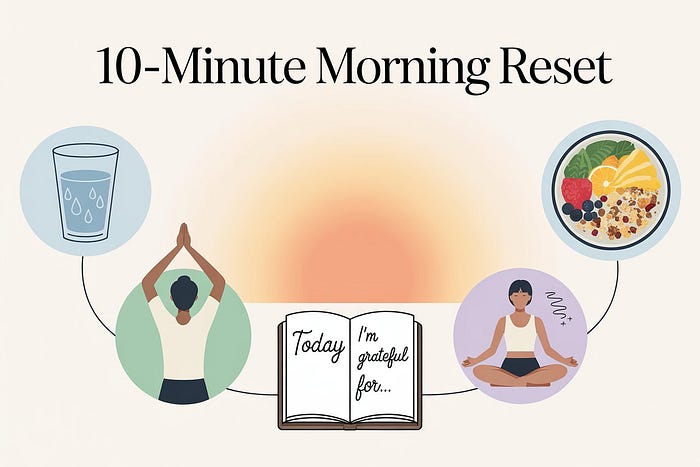
Let's face it: your morning routine frequently determines the remainder of your day. You understand exactly what I mean if you've ever used the snooze button too frequently, staggered out of bed feeling drowsy, and spent the first hour of your day in a reactive, anxious daze. It's difficult to change the tone created by such frenzied intensity.
However, what if you could change the course of events? What if your first thirty to sixty minutes of the day might serve as a potent springboard for concentration, productivity, and true wellbeing?
I'm not referring to a strict, impractical schedule that calls for taking an ice bath or getting up at four in the morning (unless that's your thing). Instead, I'm offering a useful, scientifically supported 6-step morning health regimen that can make you feel more at ease, invigorated, and prepared to take on any challenge. This is about intention, not perfection.
This is the six-step morning wellness regimen that can help you succeed.
Step 1: The Wake-Up Call "5-4-3-2-1"
Let's start with the first, and possibly most difficult, step: waking up when your alarm goes off. The temptation to press the snooze button is strong, but it's a trap. The additional nine minutes of interrupted sleep doesn't make you feel more rested; on the contrary, it makes you more susceptible to sleep inertia, which is a drowsy, confused feeling that can persist for hours.
Anxiety can also be increased by staying in bed and thinking about things before your feet even touch the ground. A "countdown" approach is a more successful tactic. Count down from five to one, and when you reach one, physically push yourself out of bed—a technique made popular by Mel Robbins. The science supports this behavioral intervention, showing that structured "wake-up tasks" can help individuals overcome the inertia of just waking up.
The key is to win the first battle of the day. By getting up when you intend to, you build a small but powerful reservoir of self-efficacy that carries you through the day.
Step 2: Make Your Bed & Tidy Your Space
This simple act might seem insignificant, but its psychological impact is enormous. Making your bed is the first "discipline" of the day. As Mel Robbins puts it, it's a "promise kept no matter what".
Starting your day with a small, completed task provides a visual cue of order and accomplishment. It signals to your brain that you're someone who takes care of their environment. Plus, coming home to a neat and tidy bedroom at the end of the day creates a more calming and relaxing environment to wind down in. It’s the simplest way to practice discipline and sets a precedent of productivity for the rest of your day.
Step 3: High-Five Yourself in the Mirror
This step might feel a little awkward at first. I know it did for me. But there's a profound reason behind giving yourself a high-five in the mirror.
The routine creates a moment of intentional self-appreciation. It forces your brain to focus on self-love and positive reinforcement. While traditional positive affirmations are great, this physical act is different. It requires you to look yourself in the eye and celebrate yourself for showing up.
This simple act can create a cool mental switch, offering a confidence boost and a moment of connection with yourself before you head out to connect with the rest of the world. This physical practice aligns with the principles of mindfulness—being present with yourself without judgment—and is a powerful way to ground your nervous system.
Step 4: Hydrate Before Anything Else
After a solid night's sleep (we hope!), your body is naturally in a state of mild dehydration. Your water stores have been depleted over the last 6-8 hours, and your brain is about 80% water. Even mild dehydration can impair your mood, focus, memory, and energy levels.
Drinking a large glass of water first thing in the morning—before your coffee or tea—is a game-changer. It jumpstarts your metabolism and provides your brain with the fluids it needs to function optimally. A study found that drinking about two cups (500 ml) of water upon waking can improve alertness and reaction speed.
It also helps prepare your digestive system for the day ahead, helping food and waste move through your digestive tract. While total daily fluid intake is what matters most, starting your day with water gives you a head start on your hydration goals.
Step 5: Soak in the Morning Light
One of the most effective and underutilized habits you can adopt is getting outside to view natural light within the first hour of waking up.
Morning sunlight is the primary signal that sets your body's internal clock, or circadian rhythm, for the day. When sunlight hits your eyes, it signals to the suprachiasmatic nucleus (SCN) in your brain to stop producing melatonin (the sleep hormone) and start producing the hormones and neurotransmitters that promote alertness and energy. This process "entrains" your internal clock to the 24-hour day, helping you feel awake during the day and sleep better at night.
Even on a cloudy day, the light outside is significantly brighter than the light indoors. Just a few minutes of morning light exposure can boost your energy, improve your mood, and has even demonstrated antidepressant effects. Think of it as giving your brain the "all clear" signal that the day has begun.
Step 6: Move Your Body
The final step is to get your blood pumping. You don't need to go to the gym for an intense workout, though that's fantastic if you have the time. Even a short walk, a few stretches, or a series of yoga poses is enough to reap the benefits.
Morning movement clears your mind, boosts your mood, and makes you more productive. The science backs this up. A 2025 study found that performing physical activity in the morning produced the strongest improvements in attention, working memory, and positive mood.
Exercise also increases blood flow to the brain, delivers oxygen and nutrients, and stimulates the release of brain-derived neurotrophic factor (BDNF), a protein that supports cognitive function and mood regulation. Even just 60 seconds of intense activity can have health benefits.
Personally, I’ve found that merging Steps 5 and 6 by taking a morning walk to soak in the light and get my body moving is a powerful combination. It’s a simple, effective way to clear my head, wake up my body, and set a positive tone for the entire day.
How to Make This Routine Stick
The goal of this 6-step morning wellness routine isn’t to add more stress to your life. It’s about creating a supportive and intentional start to your day.
Here are some tips to make it a habit:
- Start Small: Don't try to implement all six steps perfectly on day one. Pick one or two that resonate with you and build from there.
- Habit Stack: Link your new routine to an existing habit. For example, "After I go to the bathroom, I will drink a glass of water, and then I'll go for a short walk." This leverages the brain's natural tendency to group behaviors together.
- Be Flexible: Some days you'll have more time than others. On busy mornings, you might just have time for the "5-4-3-2-1" wake-up and hydration. That's okay. The key is consistency over perfection.
The Closing Line
This routine is about more than just checking boxes on a to-do list. It’s about taking control of your mornings and, by extension, your life. By waking up with intention, hydrating, moving your body, and setting a positive tone, you’re not just starting a routine—you're starting a revolution. You’re telling yourself that you matter, that your day matters, and you are ready to win.
Post a Comment